Mandela
This is an interesting historical accident in my life.
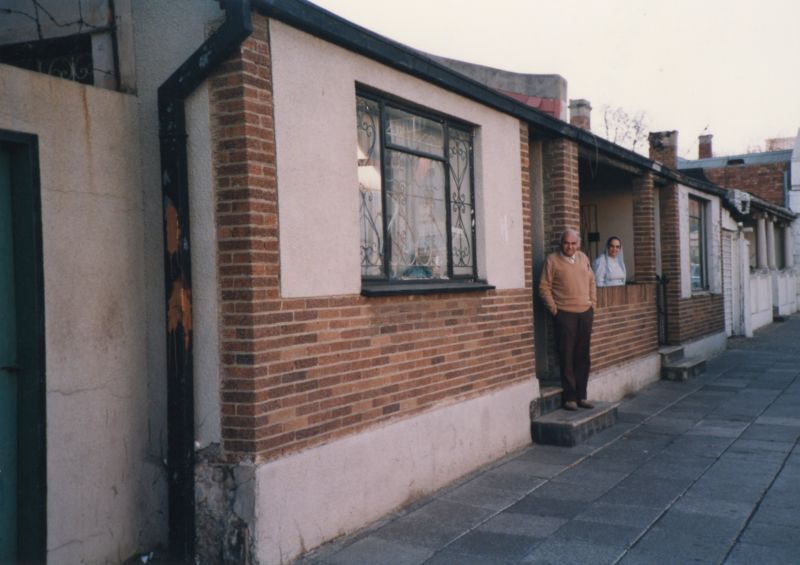
I was boarding with Ameen and Bibi Wadee in 1962. The house was at 11B Nugget Street. Johannesburg. It was my second year of Medical School which was considered to be most difficult year.
One evening Bibi came to tell me that a person would be sleeping in my room for one week and I was to keep very quiet about it.
Nugget Street was in an industrial area with a few houses. This area was safe from inquisitive neighbours.
I was surprised when my guest arrived as he was an African, Nelson Mandela.
He would dress as a security guard every morning and leave the house by about 6.30am.
He would return at 10 pm. I would be studying on the dining room table when he would arrive. I would remove my books and Bibi would make coffee. Occasionally Winnie would also come there just before Nelson's arrival.
We would have some discussion over coffee. These were light discussions. He, however did form an impression of me as a very hard working student. I felt a certain guilt at living a "normal life" whilst he was on the run from the police. He had acquired a reputation as a Scarlet Pimpernell. I asked him what I should do for South Africa. His advise to me to continue studying hard to become a doctor but to stand up for justice whenever an issue came up.
During his third or fourth day he was a little distraught when he came "home". "I almost got caught" was the first statement he made when he walked in.
He was stopped by a police road block into Soweto. He was asked my a junior police officer:- "Waar is jou pass (where is your pass)?"
He replied in Afrikaans that he had forgotten it at home.
The cop told him to wait so that he could check with his boss.
He went to senior officer in the truck.
Mandela thought that this was the end. He had to do something quick. He decided to take off his shoes and run into the bushes. Just as he had removed one shoe the cop turned around suddenly and asked him "Wat doen jay( What are you doing)?" He did some quick thinking and told him in Afrikaans that he was removing a stone from his shoes!
The cop continued towards his senior and came back a few minutes later. He told him to go but scolded him for not carrying a pass!
This is my limited anecdote of that week.
When he was arrested I never
expected to see him alive again.
In 1990 when he was released from prison I was glued to the television. To see him walk out of Polsmoor prison holding Winnies hand was one of the most emotional experience in my life. I cried and cried....... !!!!! I have never cried like that in my adult life.
Farouk
THIS 2000 INTERVIEW IN THE
CHRISTIAN SCIENCE MONITOR GIVES ONE A VERY GOOD INSIGHT INTO THE PERSON
MADIBA. HIS HUMILITY AND GENTLENESS STANDS OUT IN THE INTERVIEW.
Copyright © 2000 Nando Media Copyright © 2000 Christian Science
Monitor Service
For more about Africa,
visit Africa News Online.
The Web site of the
Christian Science Monitor, source of this article.
From Time to Time:
Nando's in-depth look at the 20th century
By JOHN BATTERSBY
(February 10, 2000 1:04 p.m. EST) - Ten years after Nelson Mandela
walked out of prison on Robben Island, and seven months after
stepping down after one term as president of South Africa, he
reflects, in an interview with the Christian Science Monitor, on
his legacy and the lasting influence his 27 years as a political
prisoner had on him.
"Whatever my wishes might be, I cannot bind future
generations to remember me in the particular way I would
like," Mandela says.
Despite peace missions, a blistering schedule of overseas travel
and stepped-up philanthropic activities, Mandela has begun to
reflect on how he wants to be remembered.
And despite his reluctance to be singled out and discuss his
personal qualities, there is consensus in South Africa that
without Mandela's personal commitment to reconciliation, his
moral authority, integrity, and intense compassion, the country's
transition to democracy might not have gone as smoothly.
Mandela is at pains to ensure that he is remembered as an
ordinary mortal with qualities that are within the reach of
ordinary people. "What always worried me in prison was (that
I could acquire) the image of someone who is always 100 percent
correct and can never do any wrong," he told one audience of
500. "People expect me to perform far beyond my
ability."
He expanded on these reflections for the first time in a recent
interview with the Monitor, which probed his philosophy of
reconciliation, the origins of his moral integrity, and the
experiences and influences that forged the qualities which have
made him one of the heroes of the 20th century.
He also spoke about the importance of religion in his life and
the crucial role of reflection and "the time to think"
during his 27 years in jail.
History will remember Mandela for having the strength of
conviction to risk engaging his jailers - and thereby humanizing
them - from inside prison and eventually setting the stage for
the African National Congress to negotiate them out of power.
Mandela sees the success of the ANC, the liberation movement he
headed before becoming South Africa's first democratically
elected president in May 1994, in mobilizing both domestic and
international opinion against the apartheid government as the key
factor.
In the interview, Mandela insisted that he wanted to be
remembered as part of a collective and not in isolation. On his
release from jail 10 years ago, he made it clear that he regarded
himself as a "loyal and obedient servant" of the
African National Congress.
"I would like to be remembered as part of a team, and I
would like my contribution to be assessed as somebody who carried
out decisions taken by that collective," Mandela says,
adding that even if he wanted to be remembered in a specific way
that was not a realistic option.
Mandela was speaking in the living room of the house he shares
with his second wife, Graca Machel, whom he married in 1998. It
is a two-story house in the plush Johannesburg neighborhood of
Houghton.
"As prisoners, we used our individual and collective
positions to make friends with some of our jailers. But this must
be understood against the bigger picture of what was happening
outside - an organized and disciplined struggle by our
organization and the international community," he says.
At the launch, late last year, of a book to commemorate him,
written by South African journalist Charlene Smith (due out in
the United States this April), Mandela insisted that he not be
elevated to some kind of sainthood.
The paradoxical side of the man is that he has sometimes taken on
superhuman tasks such as his shuttle last October to Iran, Syria,
Jordan, Israel, Gaza, and the United States in a bid to broker a
comprehensive Middle East peace.
Despite what Mandela described as "positive and
cordial" meetings with Israeli Prime Minister Ehud Barak and
President Ezer Weizman, Israel rejected his intervention. But
Mandela was not unduly discouraged.
"There are bound to be setbacks," he says.
Mandela was greatly encouraged by the eventual outcomes of his
interventions in East Timor and the handing over by Libya of
those accused of the bombing of Pan Am Flight 103 over the
Scottish town of Lockerbie in 1988. He spent seven years
mediating the behind-the-scenes negotiations with Saudi Arabia.
He says it is important that leaders should be presented to
people with their weaknesses and all. "If you come across as
a saint, people can become very discouraged," he says.
"I was once a young man and I did all the things young men
do," Mandela says, to drive home the point of his human
fallibility.
Biographers and commentators have been intrigued by Mandela's
extraordinary focus and unity of purpose during his years as a
young ANC activist and later as its spiritual leader from behind
bars.
"If you have an objective in life, then you want to
concentrate on that and not engage in infighting with your
enemies," he says. "You want to create an atmosphere
where you can move everybody toward the goal you have set for
yourself - as well as the collective for which you work.
"And, therefore, for all people who have found themselves in
the position of being in jail and trying to transform society,
forgiveness is natural because you have no time to be
retaliative. ... You want to mobilize everybody to support your
cause and the aims you have set for your life," he says.
Asked about the origins of his passionate belief in
reconciliation and forgiveness, Mandela goes into a lengthy
explanation of how he launched the Mandela Children's Fund after
a personal encounter with homeless children in Cape Town who had
come to see him to explain their plight. He was so moved that he
vowed in that moment to launch the fund, which has collected more
than $25 million and has helped hundreds of children. Mandela
donated a third of his presidential salary to the fund during his
five years in office. Many business executives matched his
example and some bettered it.
Mandela is sensitive to criticism from certain black leaders that
he has leaned over too far toward whites in his efforts to
achieve reconciliation and forgiveness. He becomes emotional when
defending his impressive campaign over the past few years to get
business leaders to donate funds for the building of schools and
clinics in the rural areas.
"Why would anyone say that I am leaning too much toward
whites? Tell me the record of any black man in this country who
has done as much as that (for black people)... I am not aware of
any other black man who has spent so much time addressing the
problems of poverty, lack of education, and disease among our
people," Mandela says, adding that he had nothing but
cooperation and support from the white business community.
When it comes to his moral authority and achievement in
persuading his jailers and their political bosses to negotiate
with him, Mandela again stresses the moral high ground of the ANC
cause.
"When you have attained the moral high ground, it is better
to confront your people directly and say: Let's sit down and
talk. So, it is not something that just comes from me. It is
something that was worked out by the organization to which I
belong."
Mandela speaks of the influence that veteran ANC leader Walter
Sisulu had had on him while in prison and how he was instrumental
in taking care of fellow prisoners regardless of their political
background.
Mandela has in turn been praised by Eddie Daniels, a former
Robben Island prisoner from a rival anti-apartheid organization,
who has told how Mandela befriended him and kept his cell clean
when he was ill.
Mandela says, "I can tell you that a man like Sisulu was
almost like a saint in things of that nature.
"You would really admire him because he is continually
thinking about other people.
"I learned a great deal from him - not only on that respect
but also, politically, he was our mentor. He is a very good
fellow ... and humble. He led from behind and put others in
front, but he reversed the position in situations of danger. Then
he chose to be in the front line."
In "Mandela: The Authorized Biography," Anthony Sampson
notes the remarkable transformation in the Mandela that emerged
from jail compared with the impulsive activist with a quick
temper he knew in the late 1950s.
Mandela does not dispute Sampson's judgment and acknowledges the
importance of mastering his anger while in prison. "One was
angry at what was happening (in apartheid South Africa) - the
humiliation, the loss of our human dignity. We tended to react in
accordance with anger and our emotion rather than sitting down
and thinking about things properly.
"But in jail - especially for those who stayed in single
cells - you had enough opportunity to sit down and think. And you
were in contact with a lot of people who had a high education and
who were widely traveled. When they told of their experiences,
you felt humbled.
"All those influences changed one," Mandela says.
Sampson quotes from a letter that Mandela wrote to his first
wife, Winnie, in 1981 after she had been jailed.
Mandela noted that there were qualities "in each one of
us" that form the basis of our spiritual life and that we
can change ourselves by observing our reactions to the unfolding
of life.
He urged Winnie in the letter "to learn to know yourself ...
to search realistically and regularly the processes of your own
mind and feelings."
In the interview, Mandela says that one of the most powerful
forces that changed him was thinking about how he had behaved and
reacted to generosity and compassion expressed toward him in the
past.
"For example, when I arrived in Johannesburg (as a young
man), I was poor, and many people helped me get by. But when I
became a lawyer and I was in a better position (financially), I
became too busy with legal affairs and forgot about people who
had helped me.
"Instead of going to them and saying: Look, here's a bunch
of flowers or a box of chocolates and saying thank you, I had
never even thought about these things. I felt that I had behaved
like a wild man ... like an animal and I really criticized myself
for the way I had behaved.
"But I was able to do this because I had time to think about
it, whereas outside jail - from morning to sunset - you are
moving from one meeting to the other, and there is no time to
think about problems. Thinking is one of the most important
weapons in dealing with problems ... and we didn't have that
outside."
Peter Ustinov, the veteran actor and author, met Mandela in South
Africa two years ago and was struck by the importance Mandela
attached to the long period of solitude in prison.
"I had a most inspiring meeting with Nelson Mandela,"
Ustinov told this reporter in an interview in the Swiss Alpine
town of Davos. "He told me with a certain amount of irony
and wickedness: 'I am grateful for the 27 years I spent in prison
because it gave me the opportunity to meditate and think deeply.
... But since I came out of prison, I haven't had the time.'
"
How has Mandela made time to think since his release from jail in
1990? He says that he has tried to emulate the practice of
businessmen who take a complete break from their work over
weekends. Mandela says he consciously has tried to make time for
reflection.
After his separation from Winnie, Mandela used to spend long
periods in retreat in the home of a wealthy Afrikaner
businessman, Douw Steyn, who ran an open house for the ANC to
hold meetings during the negotiations with the government. It was
here that Mandela proofread his autobiography, "Long Walk to
Freedom."
In November 1999, Mandela accepted an invitation to be the guest
speaker at a gala evening to mark the transformation of the house
into a luxury guest house, retreat, and conference center.
In an impromptu speech, Mandela waxed philosophical and
introspective in paying tribute to the warmth and hospitality of
his Afrikaner hosts.
"It has been said that difficulties and disaster destroy
some people and make others," Mandela began. It was a phrase
he had last used in a letter to Winnie in 1975. "Douw Steyn
is one of those who has turned disaster into success," he
said of the wealthy businessman who had formerly supported
apartheid.
"One of the most difficult things is not to change society -
but to change yourself," he said. "I came to stay here
at some of the most difficult moments, and the way Liz and Douw
treated me has left me with fond memories."
Mandela said that Douw Steyn had changed and was now part of the
white business community that was sharing its resources with the
poor. That gave him a feeling of fulfillment.
"It enables me to go to bed with an enriching feeling in my
soul and the belief that I am changing myself (by reconciling
with former adversaries)," Mandela said.
Mandela has spoken on other occasions of the importance of
giving. When he received a
bag of some 20,000 postcards in September from children who were invited to wish him well for his retirement, he said that there was nothing more important in life than giving. Tolerance is forged when people look beyond their own desires, he said.
Mandela said that religion had played a very important role in
his life. He has tended to avoid talking about the subject in the
past.
In December, Mandela addressed a gathering of religious leaders
from the world's major faiths in Cape Town. He spoke publicly
about his views on religion for the first time.
"I appreciate the importance of religion. You have to have
been in a South African jail under apartheid where you could see
the cruelty of human beings to each other in its naked form.
Again, religious institutions and their leaders gave us hope that
one day we would return."
Mandela said that real leaders were those who thought about the
poor 24 hours a day and who knew in their hearts that poverty was
the single biggest threat to society.
"We have sufficient cause to be cynical about humanity. We
have seen enough injustice, strife, division, suffering, and
pain, and our capacity to be massively inhuman. But this
gathering counters despairing cynicism and reaffirms the nobility
of the human spirit," Mandela said.
Mandela went on to say, "Religion is one of the most
important forces in the world. Whether you are a Christian, a
Muslim, a Buddhist, a Jew, or a Hindu, religion is a great force,
and it can help one have command of one's own morality, one's own
behavior, and one's own attitude."
"Religion has had a tremendous influence on my own life. You
must remember that during our time - right from Grade 1 up to
university - our education was provided by religious
institutions. I was in (Christian) missionary schools. The
government (of the day) had no interest whatsoever in our
education and, therefore, religion became a force which was
responsible for our development," he said.
The discipline of jail also played a role in his transformation,
he said.
"It was difficult, of course, to always be disciplined
before one went to jail except to say that I have always liked
sport. And to that extent I was disciplined in the sense that
four days a week I went to the gym for at least two hours.
"Also, I was a lawyer, and I had to be disciplined to keep
up with events in the legal field, and to that extent I was
disciplined," he said.
But Mandela said there were many respects in which he and his
colleagues were not disciplined when they went to jail.
"In prison, you had to follow a highly disciplined regime,
and that, of course, influenced your behavior and your
thinking," he said.
Mandela said there was also a personal discipline. "We
continued to do our own exercises, and we continued with study
and conversing with others to gain from their experiences."
He said that reading the biographies of the great leaders of the
century also had a major impact on him. Mandela said it was
though reading the biographies that he realized that problems
make some people and destroy others. Mandela said that the prison
experience taught him to respect even the most ordinary people.
"I have been surprised a great deal sometimes when I see
somebody who looks less than ordinary, but when you talk to the
person and he (or she) opens his mouth, he is something
completely different.
"It is possible that if I had not gone to jail and been able
to read and to listen to the stories of many people ... I might
not have learned these things."
(c) Copyright 2000. The Christian Science Publishing Society