"The glaring injustice is there for all who are not blinded by prejudice to see."
"I am an Afrikaner. My home is in South Africa.
I will not leave my country because my political beliefs conflict with those of the Government.
This anecdote on Bram Fisher was communicated to me by Amin Bhabha
(December 1998)
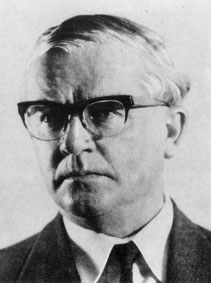
I had been hearing about him in conversations of my elders, especially Salim Saleh, Essop Tilly, Gulam Saloojee ( who were members of the Communist Party) from my tenth year. The first time I saw him in the flesh was at a public meeting in Jo'burg in 1951. This meeting was organized by the Congress of Democrats ( the successor of the CP after it was banned by the Nats). Bram was the principal speaker. I recall him as one who looked like a typical Afrikaner with thickset hair and almost a tomato-red omplexion. He was not a fiery speaker, but he spoke with conviction. The meeting was held at the Gandhi Hall in Farreira's Town close to the Kholvad House. The hall was packed. Bram spoke about the Soviet Union which he had just visited; how the revolution had changed the lives of the peoples of the various nationalities within the Union; how after the destruction and devastation inflicted by the Nazi invaders, the Soviets were rebuilding and reconstructing. There were some whites who during question period put searching and critical questions to him. I thought then that he handled them very well. He never lost his temper.
That same year, Salim Saleh told us youngsters that Bram was giving a Xmas party at his house in, I think, Houghton. Abu Dadoo, Essop Wadee and I, we went.
Bram's house was huge with a swimming pool. He and his wife were perfect hosts, made everybody feel comfortable, were modest in their behaviour and were almost embarresed when I pointed out how lovely their garden was and what lovely pieces of furniture they had The guests were people of all colours supporters of the Congress Movement plus some fellows from the Special Branch. Of course, the Congressites knew the spies ,in fact they became part and parcel of the movement. Some speeches were made. The party was a good-natured affair. Some people did get drunk because as non-whites they couldn't buy alcohol whilst at Bram's it was free and they'd get greedy. Some became unruly. One of them even wanted to bugger me up. He asked whether I was a Dadoo and I said no. He took it as slight, because he thought I was lying. I told him that a person's true character comes out when he's drunk. This was too much for him. He caught me by my tie and said something like defend yourself and I said I didn't wasn't to fight. Some people intervened and pulled him away from me. He was Paul Joseph who has been living in exile in London.
I had a few moments to speak with Bram. I told him I was impressed with his speech at the Gandhi Hall. He advised me that I should attend the Youth Festival which was to be held in East Berlin. I said I'll see. I didn't tell him I was a mere shop assistant earning nine pounds a month out which I paid three pounds for board and lodge, three pounds for eve. tuition for my matriculation. You see why I had always been reluctant to claim my blood relationship with Yusuf, because people thought I was rich little realising that I didn't have a finger in the Dadoo file. As well, I wanted to be appreciated on my own merits not on my relationship.
Back to Bram. He and his wife threw the parties every Xmas, although I attended only that once. Bram's maternal grandfather was once President of the Afrikaner Republic of the Free State. His family was well-known in Afrikaner circles. The Afrikaners had built up this myth of the VOLK and each individual had to submerge his individualism to the exigencies of the Volk. For having become a Kaffir boetie and a Koelie boetie, Bram had committed treason, for which he was reviled by his fellow-Afrikaners. This must have caused him and his wife and daughter much pain. Still, they stuck to their principles.
In 1953 I went to India to do BA and was absent for almost five years. When I returned, Bram and other Congress Movement leaders were already two years in their Treason Trial, and, although they were freed on bail, were under banning orders. His wife, on the other hand was among those who became voluntary teachers at the Congress High school in Fordsburg. You recall, the Indian High school was shut down under the Group Areas Act and moved to Lenz. The Indian Congress asked the students not to travel to Lenz and started their alternate high school. It goes without saying that the Govt, wouldn't allow such a situation to go on. The schools were forcibly shut down.
Soon thereafter, the State of Emergency was declared and the Govt. started arresting all known slanders and activists. In this regard, I must mention one detail, namely, the Special Branch fellows who as I said were part of the movement because they were always at Congress meetings taking down notes and taking pictures of people attending the meetings. Now one of them actually formed a sympathy for what the leaders were standing for. He made a phone call to Yusuf at 12.15 AM to warn him that he had 15 mins. to get out and that he should inform all his comrades to do the same. Yusuf heeded the warning and, in the little time he had, he called Harold Wolpe to warn off others.
Back to Bram: I take it that you are aware of his activities during the Emergency and Rivonia, etc.
Well, Farouk, i trust these anecdotes are helpful. Now, Brian Bunting would know a lot more, or Michael Harmel (I hope he's still alive).
Regards
Amin Bhabha